
How to Curl Giant Paper Flower Petals Without Tearing



How to Curl Giant Paper Flower Petals Without Tearing
Hello crafters! If there is one thing that separates a flat, amateur-looking paper flower from a lush, organic, high-end masterpiece, it is the dimensional curl of the petals. However, as many of us have discovered the hard way, curling giant paper petals made of thick heavy cardstock can easily lead to ugly creases, cracked fibers, or outright tears in the paper.
Today, we are going to master the subtle art of shaping heavy paper so your freestanding giant flowers look softly blowing in the wind!
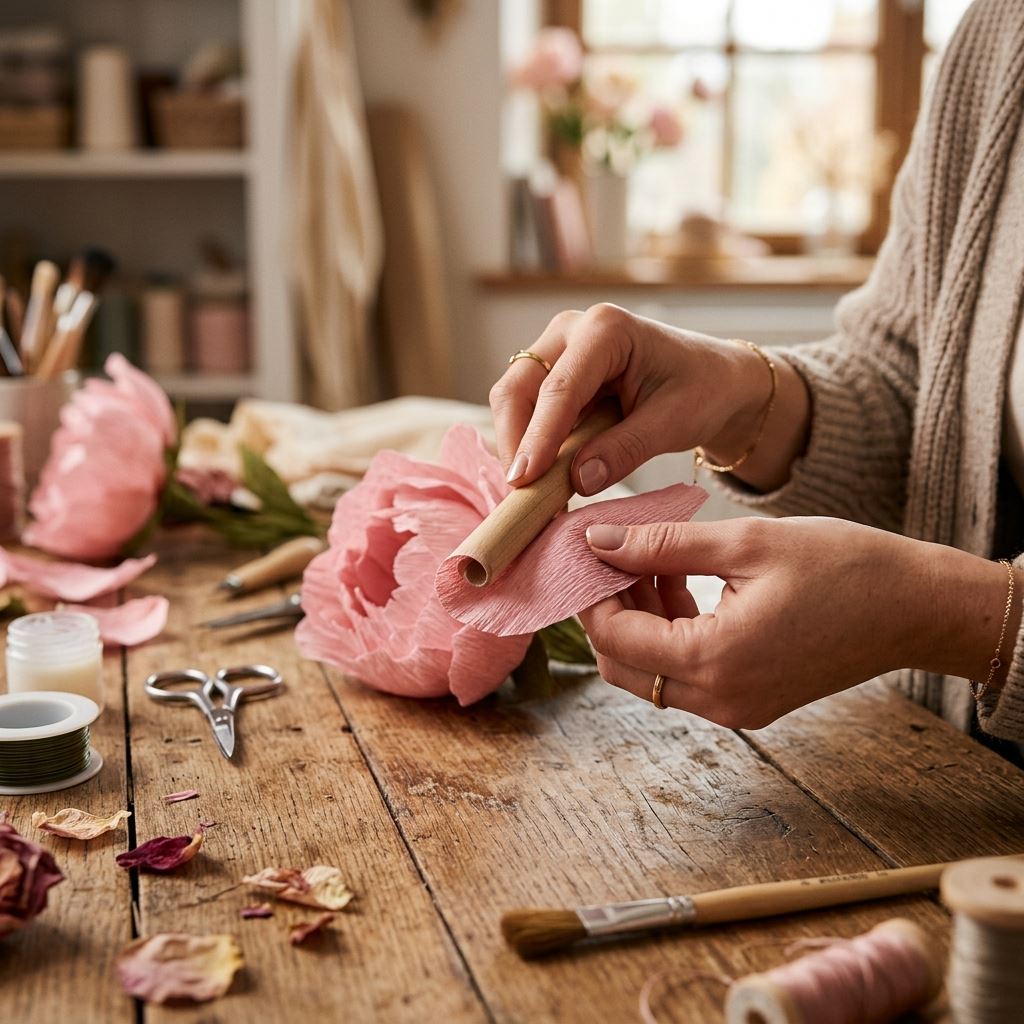
Why Heavy Cardstock Creases
Before we solve the problem, we need to understand it. Good quality cardstock (between 176 GSM and 250 GSM) is thick because it’s built from densely packed paper fibers. When you aggressively try to fold or bend it, the outer layer of those fibers stretches too far and snaps, causing a visible white crack or a sharp crease.
To achieve a smooth, elegant bend, we need to gently train the fibers to stretch.
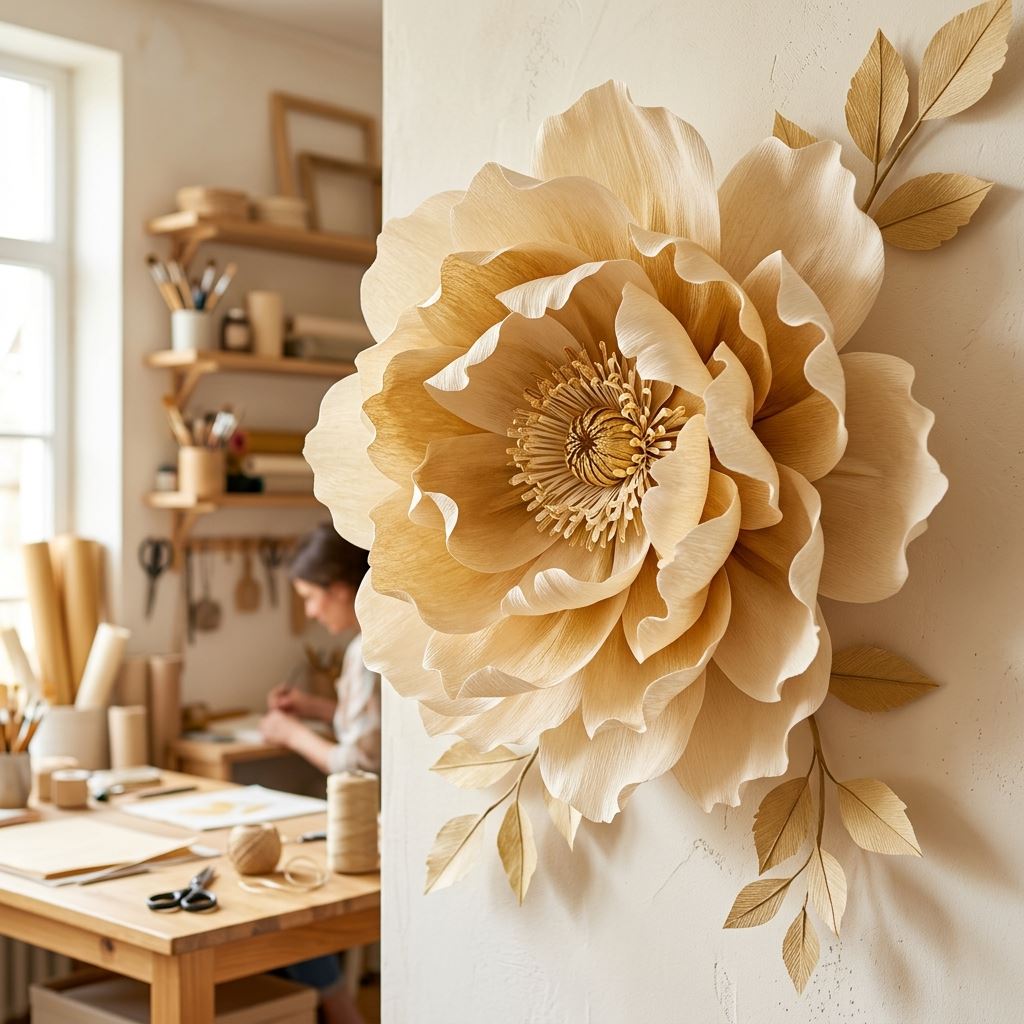
The “Dowel and Roll” Technique
This is the industry-standard method for beautiful edges.
1. Choose the Right Tool: Never use a sharp edge like a scissor blade. For giant flowers, you need something thick and perfectly round. A wooden dowel (about 1 inch / 2.5 cm in diameter) or a thick PVC pipe off-cut is perfect.
2. The Massage: Place your dowel at the tip of the petal. Place your thumb on top of the paper, pressing it against the dowel.
3. The Roll: Pull the paper back over the dowel, dragging the wood smoothly downward. Do not wrap the paper tightly around the stick in a single harsh motion. Instead, roll it back and forth gently, allowing the friction to warm up the paper slightly and persuade the fibers to curve.
The Edge Pinch (For Roses)
Real roses don’t just curve gracefully—they have sharp, dramatic pointed pinches at the outer corners.
After you have completed the “Dowel and Roll” technique to give the petal a belly, take the very outer corner of the petal between your thumb and index finger. Gently pinch the edge and roll the tip backward. This provides incredible lifelike dimension and makes the flower look as if it is naturally unfolding.
Bone Folders and Scoring
If your flower design requires a stark, structural fold in the center of the petal (often seen in giant paper leaves or tropical anthuriums), you must score the paper first.
Use a bone folder tool and a ruler to draw an invisible indentation down the center of your paper. This crushes the fibers internally *before* you fold it, guaranteeing a clean crease instead of a torn edge.
Fast-Track Your Floral Journey
Perfecting your curling technique takes a little bit of practice, but it’s incredibly meditative once you get the hang of it. What shouldn’t take practice, however, is trying to calculate the mathematical proportions of your petals!
If you want to skip the frustrating trial-and-error design phase, take a look at our premium [Digital PDF Petal Templates](https://giantflowersvietnam.com/courses). Not only do you get precise download-and-print outlines for flawless petals, but our premium video courses will show you high-definition real-time demonstrations of how I curl and assemble these giant blooms. Grab a template today, and let’s get crafting!
Frequently Asked Questions
Q: Why does my heavy cardstock crack even when I use a wooden dowel?
A: If you are using a dowel and your paper is still cracking or creasing, there are usually three main culprits. First, you might be pressing too hard. Curling giant paper petals is about gentle manipulation and friction, not brute force. Second, the diameter of your dowel might be too small; a pencil or a thin skewer will create a bend that is too sharp for 250 GSM paper, causing the fibers to snap. Always use a thick dowel (at least 1 inch thick). Finally, it could be the quality or grain of the paper itself. Paper has a “grain direction” much like wood. If you try to curl against the grain, it is far more likely to crack. Try rotating your template 90 degrees before cutting to see if it curls more smoothly along the opposite axis.
Q: Can I use heat to help curl paper petals like I do with EVA foam?
A: While heat is the primary tool for shaping EVA foam, it is generally ineffective and highly risky for curling standard cardstock paper. Paper does not melt or stretch when exposed to heat; it simply dries out, becomes brittle, and will eventually scorch or catch fire if a heat gun is held too close. However, a very slight amount of warmth and moisture can help. Some crafters lightly mist the back of the petal with a tiny spray of water to slightly relax the wood fibers before curling. Be warned that this requires extreme caution, as too much water will completely ruin the paper’s structural integrity.
Q: How do I fix a petal if I accidentally crease it down the middle?
A: Unfortunately, once the internal fibers of heavy cardstock are crushed into a sharp crease, it is impossible to completely erase the line. However, you can often camouflage the mistake! If the crease is minor, try gently messaging the paper over your wooden dowel in the opposite direction to soften the harsh angle. If the crease is severe, you can intentionally incorporate it into the design. Use your bone folder to make the crease sharp and deliberate, turning a mistake into a “vein” detail. If it looks entirely out of place, the best option is usually to cut a new petal, as a damaged base petal can compromise the structure of the entire giant flower.
Q: Do I need different curling techniques for different types of giant flowers?
A: Yes! The way you curl a petal fundamentally defines the species of the flower. For a classic giant rose, you will use the “Dowel and Roll” technique to create a deep belly, followed by pinching the outer tips backward for a sharp, unfolding look. For a giant peony, you want a softer, more crumpled look, which can be achieved by gently crushing the edges of the petal in your hands rather than using a rigid dowel. For a giant daisy or sunflower, the petals are mostly flat with only a very slight, uniform downward curve, requiring just a single, light pass with the dowel. Understanding these subtle differences is key to creating lifelike floral art.
📚 Related Giant Flower Guides
- Read Next: Learn more about Paper Weight For Giant Flowers in our detailed guide on The Ideal Paper Weight for Giant Freestanding Paper Roses.
- Read Next: Learn more about Eva Foam Giant Flowers in our detailed guide on EVA Foam vs Cardstock Paper: Which is Best for Giant Flowers?.