Heavyweight vs. Lightweight Cardstock for Giant Flowers

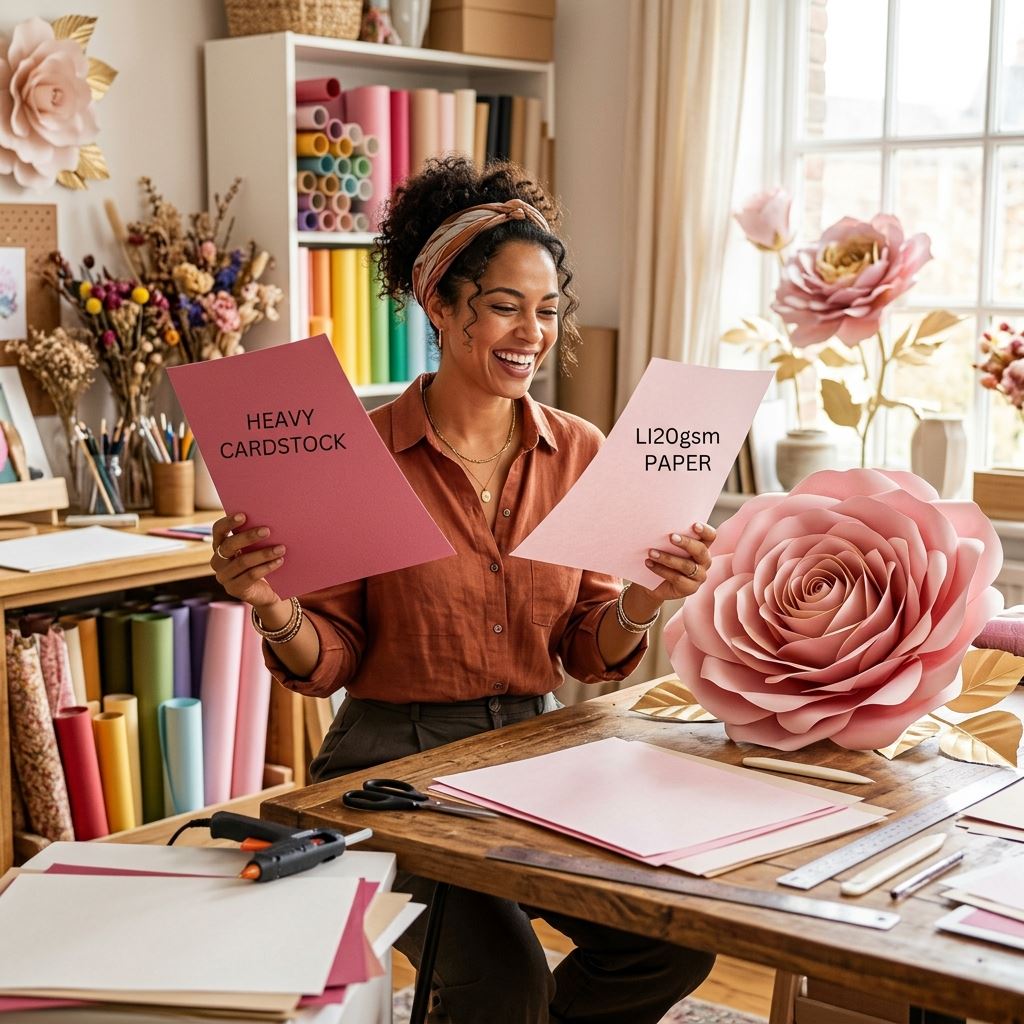
Heavyweight vs. Lightweight Cardstock for Giant Flowers
I get this question at least three times a day: “What is the best paper for giant flowers?”
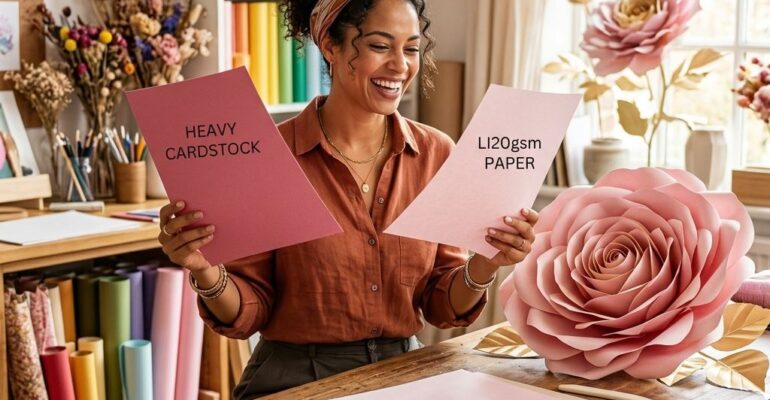
It seems like a simple question, right? But if you’ve ever walked into a paper warehouse or spent an hour browsing online, you know that “Cardstock” is a massive category. You’ve got 65lb, 80lb, 110lb, 176gsm, 250gsm… the numbers alone are enough to make your head spin!
The truth is, the “best” paper depends entirely on *what* you are making. A tiny, delicate peony and a massive 1-meter rose require completely different structural foundations. Today, I’m going to break down the science of paper weight so you never have to guess again. Let’s find your perfect match.
1. Lightweight Cardstock (120gsm – 160gsm / 65lb)
This is the “entry-level” paper for many crafters.
* The Pros: It is incredibly easy to cut by hand. If you have any issues with hand strength, this is the best paper for giant flowers in terms of comfort. It also curls like a dream—you can get very tight, elegant swirls on your petals.
* The Cons: It lacks “backbone.” If you try to make a flower larger than 30cm (12 inches) with this weight, the outer petals will likely sag under their own weight. It’s also very sensitive to humidity.
* Best For: Small to medium wall flowers, nursery decor, and intricate inner layers of large blooms.
2. Mid-weight Cardstock (176gsm – 210gsm / 80lb)
If I had to pick one “Desert Island” paper, this would be it. This is the industry standard for professional paper artists.
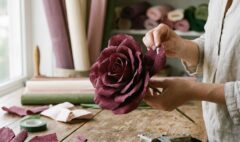
* The Pros: This is the best paper for giant flowers because it balances flexibility with strength. It’s sturdy enough to stand up in a 60cm bloom but still thin enough to be curled with a PVC pipe or dowel.
* The Cons: It can be a little tougher on your hands if you are cutting 100 petals a day. (Pro tip: Invest in high-quality ergonomic scissors!)
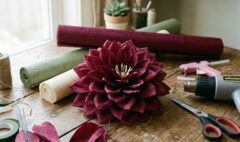
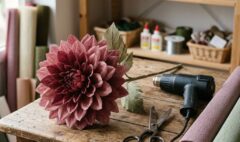
* Best For: 90% of your projects. Roses, Dahlias, and backdrop walls.
—
The Secret to Perfect Proportions with Giant Flowers Vietnam…
Do you struggle with your flowers looking “limp” even when using heavy paper? It might not be the paper—it might be the template! At Giant Flowers Vietnam, we’ve tested our designs across every weight imaginable. Our PDF templates are engineered to provide maximum structural support. We even show you the “Double-Petal” technique for when you want to use a beautiful lightweight paper but need the strength of a heavyweight one. We take the “math” out of the craft so you can focus on the colors. You don’t need a cutting machine; you just need our templates and the right advice on the best paper for giant flowers.
—
3. Heavyweight Cardstock (250gsm+ / 110lb+)
This is the “heavy lifter” of the paper world.
* The Pros: It is nearly indestructible. If you are building a massive installation in a high-traffic area (like a hotel lobby), this is the way to go. It feels premium and expensive to the touch.
* The Cons: It is very difficult to curl. You won’t get soft, organic waves with this paper; you’ll get architectural, bold folds. It can also be very heavy, meaning you need a serious mounting system to keep it on the wall.
* Best For: Floor-standing flowers, very large base petals, and structural leaves.
4. Special Textures: Shimmer vs. Matte
Beyond the weight, you have to consider the finish.
* Matte: This is the best paper for giant flowers if you want them to look “natural.” It photographs beautifully because it doesn’t reflect the flash of a camera.
* Shimmer/Metallic: This is perfect for high-glamour events. However, shimmer paper is often “coated,” which can make it harder for hot glue to stick to. You’ll need a high-temp glue gun to melt through that coating for a secure bond.
5. My Secret “Golden Rule”
If you are ever in doubt, follow this rule: The bigger the petal, the heavier the paper.
For a giant flower, I often “mix and match.” I use 210gsm for the outer 2 layers to provide a strong frame, and then I switch to 160gsm for the inner layers so I can get those delicate, tight curls in the center. This gives you a flower that is structurally sound but looks soft and romantic.
📚 Related Giant Flower Guides
- Read Next: Learn more about Crepe Paper Flower Tutorial in our detailed guide on How to Dye and Stretch Crepe Paper for Realistic Giant Petals.
Summary
Choosing the best paper for giant flowers is a skill that comes with time, but starting with the right weight will save you hours of frustration. 176gsm to 210gsm is your safe zone.
Frequently Asked Questions (FAQ)
1. Can I use my home printer to print templates directly onto heavyweight cardstock?
Most standard home inkjet or laser printers can handle cardstock up to 65lb (around 176gsm). However, heavier cardstock (such as 110lb or 250gsm) will often jam standard printers or fail to feed properly through the rollers. For heavyweight paper, it is best to print your template on regular copy paper, cut it out, and trace it onto the thick cardstock by hand.
2. Does the texture of the cardstock affect how the giant flower is assembled?
Yes. Smooth or matte cardstock generally takes hot glue very well, creating a secure bond instantly. Textured, coated, or metallic shimmer cardstock can be slippery, meaning the hot glue may not adhere as strongly. When using coated papers, you may need to hold the petals in place longer while the glue sets, or lightly score the gluing area to create “tooth” for the adhesive.
3. Why do my giant cardstock flowers droop after a few days?
Drooping is usually caused by using cardstock that is too lightweight for the size of the petal, or by a weak base attachment. If you are making a massive flower (over 24 inches), 65lb paper will inevitably succumb to gravity. Additionally, environmental factors like high humidity can soften the paper fibers over time, causing even mid-weight cardstock to lose its structural integrity.
4. How do I prevent my cardstock from creasing when I try to curl it?
Creasing happens when the paper is bent sharply rather than rolled. To prevent this, never fold the paper. Instead, use a thick cylindrical object like a PVC pipe, a wooden dowel, or a large marker. Place the paper against the dowel and gently pull it through your fingers, applying even, sweeping pressure to break the fibers gradually and create a smooth, continuous curl.
Ready to put that paper to use? Visit Giant Flowers Vietnam to download our templates and see how the right paper and the right design can create magic!
[Link to Course/Template]